Claim Support → Rejected claim
Your claim was rejected. Here's exactly what to do next.
A rejected claim is not the end. Most rejections can be challenged — and many are overturned — if you act methodically in the first 48 hours. Ask for the rejection in writing, match the stated reason against your policy document, gather the counter-evidence, file a written grievance with the insurer, and escalate to IRDAI and the Insurance Ombudsman if the insurer doesn't resolve it.
First: the 5 steps to take in the next 48 hours
- Get the rejection in writing. The insurer must issue a repudiation letter stating the exact reason and the policy clause it relies on. A verbal "no" on a phone call means nothing — insist on the letter.
- Match the reason to your policy wording. Every rejection cites a clause. Find that clause in your policy document. If the insurer's reading of it is stretched or wrong, that's the core of your appeal.
- Collect your counter-evidence. Hospital records, discharge summary, doctor's notes, diagnostic reports, payment receipts, your original proposal form. Organised paperwork wins appeals.
- File a written grievance with the insurer. Every insurer has a grievance cell and must respond within {{VERIFY: 15 days}}. Keep the acknowledgement number.
- Escalate if unresolved. If the grievance fails, you have two free, powerful options: IRDAI's Bima Bharosa portal and the Insurance Ombudsman. Both are explained in our escalation guide.
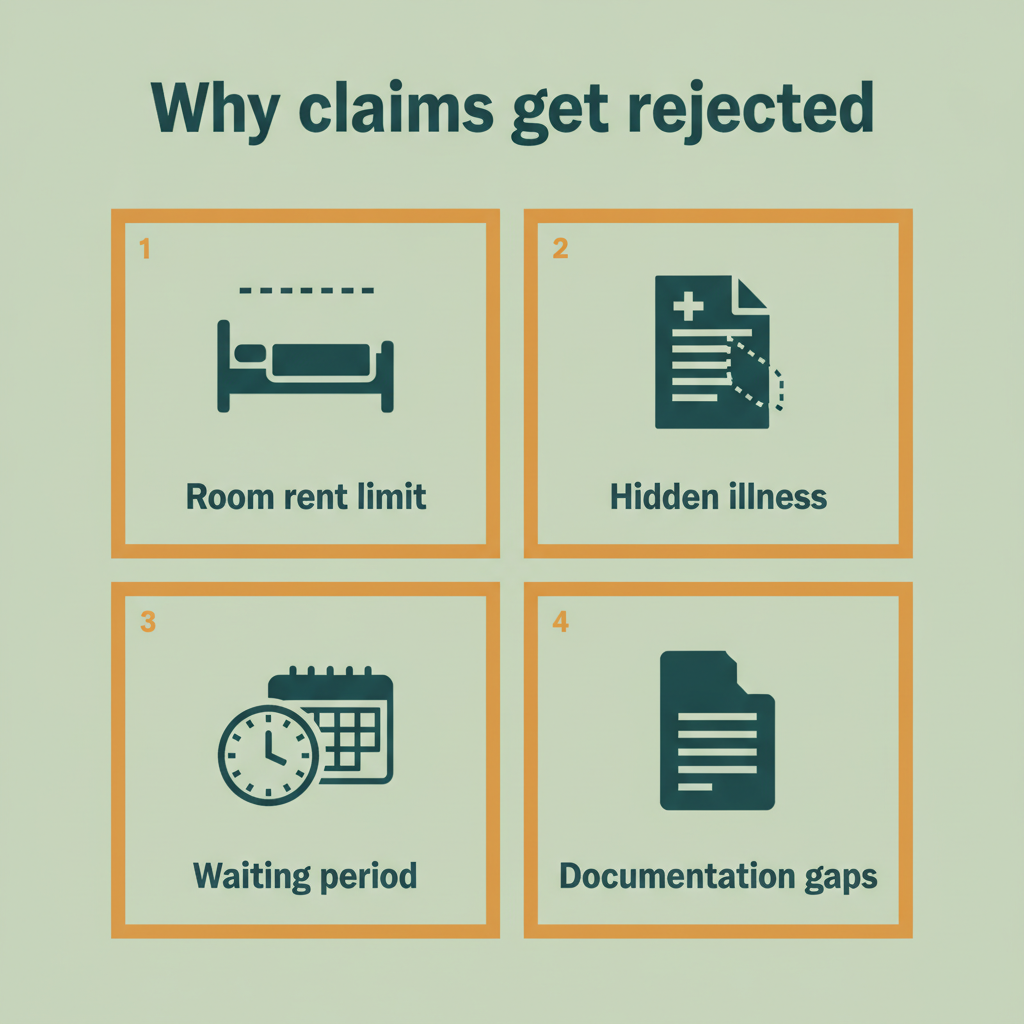
Why health insurance claims get rejected
Room rent limit crossed
Many policies cap room rent (e.g. 1% of sum insured per day). Choosing a costlier room can proportionally cut your entire bill — not just the room charges.
Pre-existing disease (PED) disclosure
If a condition existed before you bought the policy and wasn't disclosed, the insurer can reject the related claim. The most common — and most contested — rejection reason.
Waiting period not over
Specific illnesses and PEDs carry waiting periods (often 2–4 years). A claim inside that window is contractually excluded.
Documentation gaps
Missing reports, unsigned forms, mismatched names, late intimation. The most fixable rejection reason of all.
How to read your rejection letter
Every repudiation letter has three parts: the reason, the clause it cites, and what you can do next. Write back asking for clarification on anything vague — insurers must respond in writing. If the letter cites "non-disclosure", ask exactly which fact they believe was not disclosed and which medical record they base it on.
The appeal ladder: from grievance cell to Ombudsman
Step 1: insurer's grievance cell (written). Step 2: IRDAI's Bima Bharosa portal. Step 3: the Insurance Ombudsman — free, no lawyer needed, and the award is binding on the insurer up to {{VERIFY current monetary limit}}. Full walkthrough with a complaint template: How to file a Bima Bharosa & Ombudsman complaint →
How GampInsure handles this for you
Send us your rejection letter on WhatsApp. Within 4 working hours, an advisor will tell you: whether the rejection is challengeable, what evidence would overturn it, and — if you want — take over the entire appeal. This review is free, whether or not you bought your policy from us.
Your questions, answered
Can a rejected claim be approved later?
Yes. Many rejections — especially documentation gaps and misapplied clauses — are overturned at grievance or Ombudsman stage when challenged with the right evidence.
How long do I have to appeal?
Raise the insurer grievance immediately. For the Ombudsman, you generally need to approach within {{VERIFY: one year of the insurer's final reply}}. Don't sit on a rejection letter.
Do I need a lawyer?
Not for the insurer grievance, Bima Bharosa, or the Ombudsman — all three are designed for policyholders to use directly, free of cost.
What if the rejection is genuinely valid?
Then an honest advisor should tell you that too — and help you structure the next policy so it can't happen again. We'd rather lose a sale than have you discover an exclusion at claim time.